More deck isn’t automatically better. A floating sun deck extension for a pontoon boat could mean a compact lounge zone, a side extension or a wider platform. The right layout depends on available space, how people move around the boat and how the added surface affects loading and exposure to water.
It’s easy to picture a bigger, more relaxing spot to stretch out, but an extension needs to work with the boat’s existing layout, not against it. This guide explains how to assess usable deck space, compare three layout choices and reduce the risk of corrosion and water damage. You’ll come away with practical considerations for shaping a comfortable sun deck while keeping everyday access and care in mind.
Key Takeaways
- Measure usable deck space and consider how an extension could affect seating, movement and access around the boat.
- Compare layout options by how they use the available space and suit the way you plan to relax on board.
- Estimate costs by considering the extension’s size, materials and design complexity rather than relying on a one-size-fits-all figure.
- Choose materials and care practices with water exposure and corrosion in mind, and keep damp areas clean and dry.
- Assess added weight and buoyancy against your boat’s capacity before making changes; for a separate floating leisure option, explore Crocpad’s Floating Water Mat.
1. Pontoon deck space and layout
A pontoon boat has two pontoons serving as hulls and a main platform serving as its deck. Seating often runs around the perimeter, leaving the centre open for movement, socialising or lounging. That open space may look spare, but it also carries foot traffic between the helm, seats and boarding points.
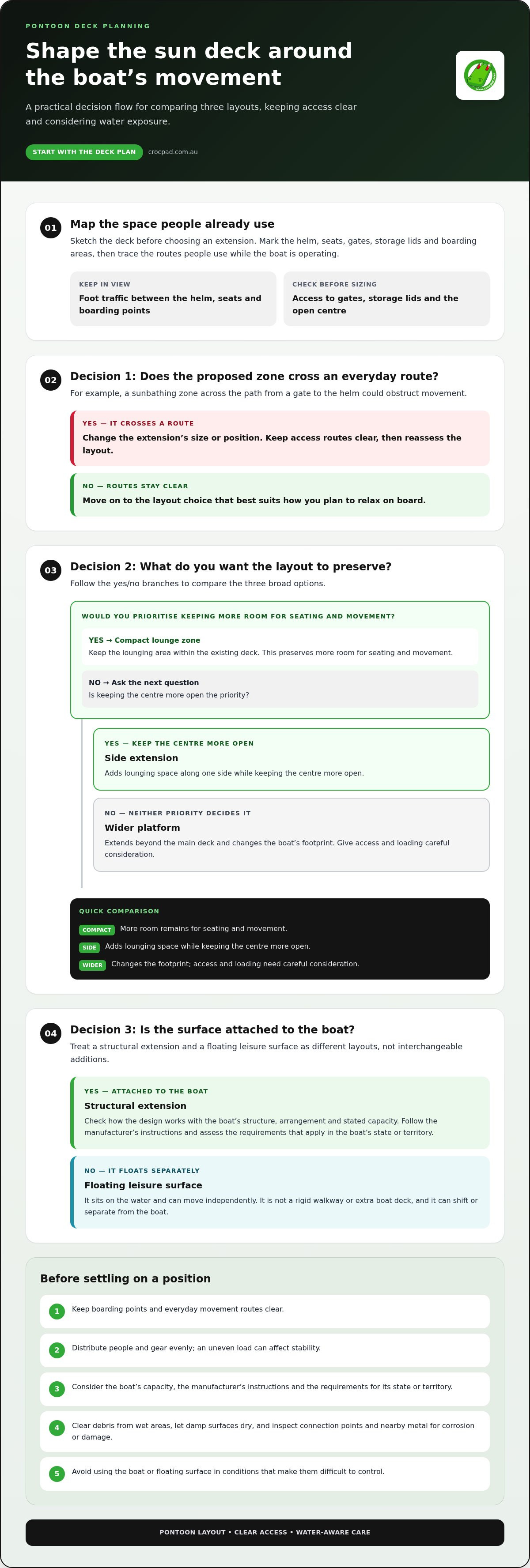
Start by sketching the deck. Mark the helm, seats, gates, storage lids and boarding areas, then trace the routes people use while the boat is in operation. A sunbathing zone across the path from the gate to the helm, for example, could obstruct everyday movement. Keep access routes clear before settling on an extension’s size and position.
Compare three broad layouts: a compact lounge zone within the existing deck, an extension along one side, or a wider platform beyond the main deck. A compact zone preserves more room for seating and movement. A side extension can add lounging space while keeping the centre more open. A wider platform changes the boat’s footprint, so access and loading need careful consideration.
A floating sun deck differs from a fixed platform or swim deck: it sits on the water rather than forming a rigid surface mounted to the boat. A fixed deck is attached to the boat, while a floating option can move independently with the water. Treat them as different layouts, not interchangeable additions.
For Australian boating rules, assess the proposed change against the requirements that apply to the boat’s state or territory, its capacity and its use. Follow the boat manufacturer’s instructions too, particularly if an extension changes the deck’s load or arrangement.
Consider safety before choosing a position. A floating surface can shift or separate from the boat, while an uneven load can affect stability. Keep boarding points clear, distribute people and gear evenly, and avoid using the boat or floating surface in conditions that make them difficult to control.
In Australia, pontoon dealers and marine fabricators are channels for buying or commissioning a purpose-built extension. Share the boat model and a deck plan so the design can account for its structure, access points and intended use. A floating water lounge is different from a structural extension, so choose the option that matches the job.
Consider how water exposure affects the boat and any added components. Clear trapped debris from wet areas, let damp surfaces dry, and inspect connection points and nearby metal for corrosion or damage. Regular checks can reveal problems before they affect the deck or its use.
3. Are pontoon boat sun deck extensions available in Australia?
The suitable option depends on the pontoon model and the type of extension you want. A removable floating platform and a deck attached to the boat are different products, so define the project before comparing options. For a fixed addition, start with the boat’s make and model, then look for product information that applies to that vessel.
Use the owner’s manual and manufacturer information to understand the existing deck structure and any stated limits. Sketch the proposed location, gates, helm, seats and storage. This gives you a clear basis for discussing whether a design suits your pontoon, without assuming an accessory for another model will fit.
If a ready-made option doesn’t suit your layout, describe the project to a marine fabricator and ask what information is needed to assess it. Share the pontoon’s model, photographs and measurements of the intended area. Mark where passengers board and where deck lids open, for example. These details can reveal practical fit issues before a design is developed.
Before comparing options, decide whether you need a structural extension or a floating leisure platform. An attached deck changes the boat and must work with its structure. A separate platform floats beside it; it is not a rigid walkway or extra boat deck. This distinction helps you interpret product descriptions and avoid comparing unlike options.
Use these steps to make your enquiry specific:
- Write down the pontoon’s make and model.
- Photograph the intended area, including nearby fittings and access points.
- Measure the available space and note where people need to move.
- Describe whether you want an attached surface or a separate floating platform.
- Use the boat’s documentation when discussing capacity and design suitability.
Consider the boat’s conditions of use too. Think about whether the pontoon is used in fresh or salt water, and how sun and spray affect materials. Ask for care instructions alongside design details so you know how to clean and inspect the finished setup. Keep that guidance with the boat’s records for future reference.
If you’re considering a separate floating option rather than a structural addition, Crocpad’s floating water recreation products offer a different way to enjoy time on the water. A floating mat is not a sun deck extension, so assess it according to its own intended use. Match your choice to the experience you want, then assess any pontoon modification separately.
Keep the existing seating arrangement in view when assessing a possible sun deck extension. Pontoon seating is usually arranged around the edge, leaving the middle available for activities or socialising. Consider how a proposed surface relates to the open middle and edge seating, and whether it suits the way you plan to use the space. This makes layout discussions more specific.
4. How much does a pontoon boat sun deck extension cost in Australia?
There’s no single useful price for every Australian pontoon sun deck extension. The cost depends on whether you’re buying a separate floating platform or commissioning a structure attached to the boat. These are different projects with different materials, design work and fitting requirements. A compact removable surface beside a pontoon has a different scope from a custom deck built around fixed seating.
For an attached extension, the boat’s make, model and deck construction shape the work. A design that uses an existing mounting arrangement may require less adaptation than one built around unusual seating, gates or storage. Size matters too: a larger surface needs more material and may need additional structural support. A marine fabricator must also consider access, finish and how the addition connects to the boat.
Materials affect both the initial quote and ongoing care. Compare the deck surface, support structure, fasteners and finishes as a complete system. A material suited to freshwater use, for example, may need a different maintenance approach in saltwater. Ask the quote to identify each material and its intended use, rather than comparing totals with different specifications.
Installation scope can change the total. One quote may include design, fabrication, delivery, fitting or finishing, while another covers only the fabricated component. Confirm what each line includes and whether existing fittings need modification. If the boat must be transported or access at its usual berth is difficult, clarify how those details are covered in the quoted scope.
Build a like-for-like comparison before deciding:
- Describe whether you want a removable floating platform or an attached deck extension.
- Provide the pontoon’s make, model and photographs of the proposed area.
- Mark the helm, seating, gates and storage that the design must leave accessible.
- Ask for materials, fabrication, delivery and fitting to be itemised separately.
- Compare the proposed load and maintenance requirements with the boat’s documentation.
For example, compare two quotes for the same pontoon, footprint and finish. If one includes fitting and the other covers fabrication only, the totals don’t represent the same job. Check the scope before choosing the lower figure. Keep maintenance in view too: cleaning, drying and inspecting fittings are part of ownership, especially after saltwater use.
A separate floating leisure platform avoids changing the boat’s deck structure, but it isn’t a substitute for a rigid extension. Price comparisons should reflect that difference. Define the purpose first, then use the boat’s model, intended layout and material requirements to request a clear Australian-dollar quote. This gives you a more useful basis for budgeting than a generic price range.
5. What materials and designs are best for a floating pontoon sun deck?
The right choice depends on whether the deck floats independently or attaches to the pontoon. These designs need different construction, connections and care. For a separate platform, assess buoyancy, surface grip, drainage and how it stays alongside the boat. For an attached deck, consider the existing structure, fittings and manufacturer’s guidance.
Compare materials based on exposure to water, sun and salt, not appearance alone. Marine-grade aluminium is commonly considered for a lightweight frame, while stainless steel fittings can suit exposed connections. Suitability depends on the specific grade, finish and contact with other metals. Ask for material specifications and compatible fasteners, not just a general label such as “marine grade”.
A deck surface should suit bare feet, wet use and regular cleaning. Textured surfaces can help provide grip, but deep grooves may hold water or debris. Smooth surfaces can be easier to wipe, yet may become slippery when wet. Inspect a sample if possible, and consider how sunscreen, sand and salt spray affect cleaning.
Choose a layout that suits the intended activity. A simple rectangular platform can create a clear lounging area beside the boat. A narrower design may preserve more room for boarding and movement. Keep edges easy to see, avoid sharp corners near entry points, and leave room to reach cleats and other fittings.
Use this comparison when reviewing a design:
- Frame: Check the stated metal grade, finish and connection method.
- Surface: Look for practical grip, drainage and straightforward cleaning.
- Fasteners: Confirm they suit the frame and the water conditions.
- Shape: Match the footprint to boarding access and intended lounging space.
- Care: Check how the design allows water to drain and surfaces to dry.
Corrosion prevention starts where different metals meet. An aluminium frame joined directly to another metal, for example, may need an appropriate isolation method. Ask the designer to specify compatible fittings and explain how to inspect each connection. Rinse off salt deposits after use, dry trapped moisture and check for damaged coatings or loose hardware.
Water damage can build up in hidden spots. After a day on the water, check beneath cushions, around seams and under removable surfaces. Wipe wet seating and let excess moisture clear before fitting a tight cover. Remove wet towels and open damp storage compartments when possible. These simple steps help surfaces dry instead of trapping moisture.
Match maintenance to the material and the boat’s environment. A platform used in saltwater needs careful rinsing and regular fastener inspections. Follow the pontoon manufacturer’s maintenance instructions, and keep the extension’s care guidance with the boat documents. A suitable design fits the intended use, drains well and remains accessible for cleaning.
5. Can a pontoon boat safely support a sun deck extension, and how is buoyancy calculated
A pontoon can support an extension only if its structure, buoyancy and rated capacity can handle the complete loaded arrangement. Account for the extension itself, passengers, gear and existing equipment. A separate floating platform has its own buoyancy, but its connection to the boat can still affect movement and loading.
Buoyancy comes from water displaced by a submerged object. In practical terms, calculate the volume of each pontoon below the waterline, then determine the weight of the displaced water. That represents the buoyant force available at that draft. Subtract the pontoon’s own weight and the boat’s other loads to understand the remaining support capacity.
A real assessment requires reliable dimensions and weight figures. Record each pontoon’s length and submerged cross-section at the boat’s operating waterline. Then account for the hulls, deck, engine, fuel, people, equipment and proposed extension. Use the boat manufacturer’s information for relevant capacity and maintenance guidance. Don’t treat estimates based on visible dimensions as a safe load limit.
Position matters as much as total weight. A heavy extension concentrated at one end can alter trim, while a load on one side can make the boat sit unevenly. Placing several passengers and gear on an outboard platform, for example, changes the load distribution compared with keeping them centred. Account for people moving, boarding and shifting position during use.
Use this assessment sequence:
- Identify whether the proposed deck attaches to the pontoon or floats independently.
- Gather the boat’s capacity and manufacturer information.
- List the extension, passengers, fuel, equipment and existing fittings as loads.
- Assess the load’s position, not just its combined weight.
- Check how the design affects waterline, trim, freeboard and access.
For an independently floating deck, use its stated buoyancy and load information. Consider how much of the platform sits underwater under load, and whether its connections allow movement without pulling the boat off balance. Spread people and gear across the usable surface. Stop using a platform if it shifts, lists or sits lower than its design allows.
Neither a simple volume calculation nor a visual check establishes that a modified pontoon is safe. The boat’s construction, loading arrangement and extension design all matter. Follow the manufacturer’s instructions and have structural changes assessed by a suitably qualified marine professional. For separate leisure time on the water, explore floating water recreation options.
In a strut pontoon design, diagonal stainless steel cable braces run between the gangway and strut for lateral support. This supports that connection, but does not state how much weight the boat can carry or establish the buoyancy available for an added deck. Keep the questions distinct: bracing is a structural detail, while displacement and capacity information relate to loading. Don’t infer a safe extension load from the presence of braces alone. Assess the complete loaded arrangement and the boat’s construction before deciding whether the extension is suitable.
Crocpad: Floating Water Mat
Crocpad’s Floating Water Mat offers a separate way to relax on the water, without attaching a deck extension to your pontoon. It suits boat owners looking for a floating leisure surface rather than a structural addition that changes the boat’s layout or load.
Keep the distinction clear: a floating mat isn’t a rigid platform, walkway or substitute for a sun deck extension. Choose it for relaxing on the water, and assess any boat modification separately for fit, loading and safety. Crocpad also offers the Beer Pong Floating Mat for social floating fun.
Explore the Floating Water Mat as a separate option for your days on the water. Visit crocpad.com.au to explore Crocpad’s offerings.
Plan your next day on the water
Before choosing a floating sun deck extension for a pontoon boat, decide whether you want a permanent change to the boat or a separate place to relax on the water. Keep that distinction in mind as you plan your next outing. A structural extension needs to suit the boat; a floating leisure product offers another way to enjoy the water without becoming part of the deck.
If you’re after water-based fun beyond a deck modification, Crocpad offers a Floating Water Mat, Minima Pool Slide and Megalo 3M Inflatable Water Pool Slide. Each is a separate recreational option, not a pontoon extension or installation service. Choose the kind of experience that fits your plans, then make sure any boat alteration is assessed for your vessel and its intended load.
Ready to explore Crocpad’s water recreation products? Visit Crocpad online and find an option for your next day on the water.
Frequently Asked Questions
What is a floating sun deck extension for a pontoon boat?
A floating mat is a separate, buoyant surface for lounging on the water beside a pontoon. Unlike a fixed swim deck, it isn’t built into the boat’s structure. It can provide a place to stretch out while the pontoon remains the main vessel. Treat it as a floating platform, not extra boat deck space or a rigid walkway.
What are the weight capacity and dimensions of common pontoon sun deck extensions?
Dimensions and rated capacity depend on the specific design, so no single size or load figure applies to every extension. Compare the platform’s stated length and width with the available space and boarding access. Then account for everyone using it and any gear. Even a platform that fits beside the pontoon needs a load rating suited to its intended use.